



Pete Carril’s Hall of Fame career got boost from days coaching at Reading High
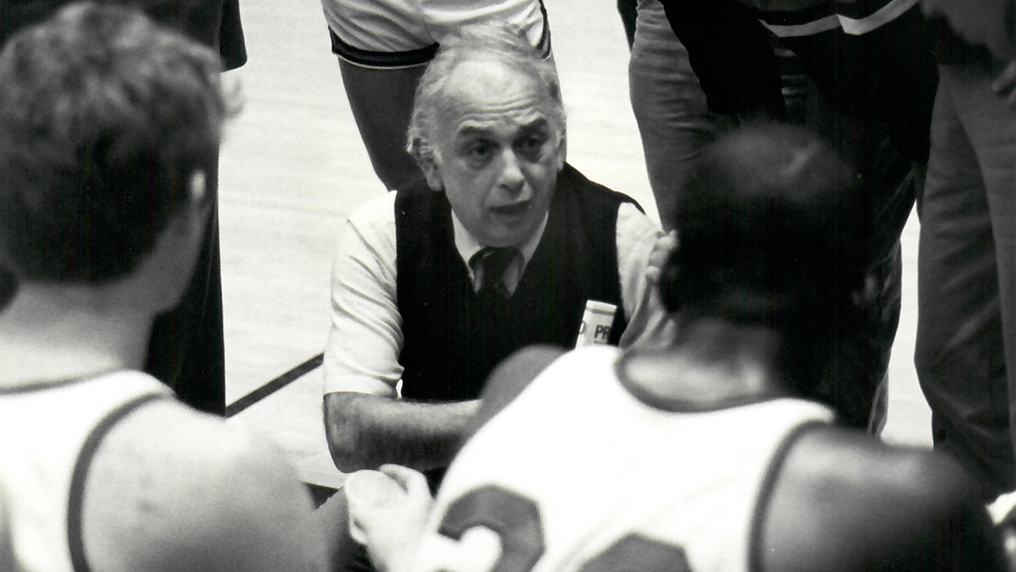
The roots of Reading High’s basketball success reach all the way to the 1950’s and Pete Carril’s eight-year reign as Red Knights coach.
He stressed the fundaments of the game and instilled a desire to play defense, leaving a lasting impact.
“Pete set the tone for what Reading basketball is today,” said longtime Reading Eagle sportswriter Tony Zonca upon learning of Carril’s death Monday at age 92. “Pete set the tone, passed it on to Jut (Misbach), and passed it on to Jim (Gano), and Jim passed it on to Rick (Binder) and so on and so forth down the line.”
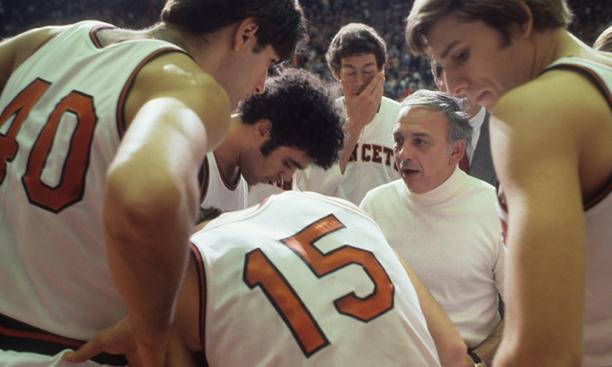
Carril became a legend of the game during his Hall of Fame, 29-season run at Princeton, where he won 13 Ivy League titles and transformed the game.
He’s best known for creating the “Princeton Offense,” a cut-screen-and-pass offense that he began developing in Reading when he became Red Knights coach in 1958.
Carril’s own roots trace back to the Lehigh Valley, where he played at Easton and later at Lafayette for Butch Van Breda Koff. Carril went on to coach at Easton. Gano, who would become the winningest coach in Reading High history, played for Carril at Easton.
“Everything I have basketball-wise, I owe almost all of it to him,” Gano said Monday afternoon.
Carril was Gano’s JV coach and later his varsity coach with the Red Rovers. Carill moved on to Reading High where he was a social studies teacher and led the Red Knights to 145 wins and a pair of Central Penn League championships. He had a .775 winning percentage in Reading.
Gano, implementing the philosophy he learned from Carril and stressing the same old-school fundamentals, coached the Red Knights from 1971-81. His teams won six District 3 titles and reached the PIAA semifinals four times.
Carril helped Gano get into Moravian College, then hired him as a coach at Reading in 1963.
“He was a fundamentalist, no question,” Gano said of Carril. “He taught all fundamentals: fundamentals of defense, fundamentals of offense, fundamentals of how to pass the ball, how to shoot. Work ethic was (what he stressed most). He wanted you to work in practice; he got on guys who weren’t working hard.”
Carril was a demanding taskmaster as a high school coach. Gano once told Zonca: “Pete was hard to play for.”
Practice made perfect, though. Carril’s final Reading team, in 1965-66, was one of the best in program history and won its first 25 games before falling in the state semifinals.
His 1960-61 team was 23-2 and headed for the state championship game. It led 47-40 with three minutes to play before allowing Nanticoke to score the game’s final 11 points for a 51-47 win.
Carril is remembered, among other things, as a teacher of the game. Gano remembers Carril showing up to watch a Reading High practice and helping Neil Crystal with his shooting.
“As a sophomore Neil’s shot wasn’t so good,” Gano said. “Pete took Neil up into the old gym and straightened out his shot. His shot got a lot better and eventually went to Princeton (and played for Carril).”
Carril coached Lehigh for one season after leaving Reading, then coached at Princeton from 1967-1996, where he went 514-261 and made 11 NCAA tournament appearances.
Carril didn’t believe in athletic scholarships; that’s why he went to the Ivy League.
“You play basketball because you love it,” he once said. “You play it with integrity and you play it to win.”
“He had to change (his offense) because of the type of players he was getting (at Princeton),” Gano said of the birth of the “Princeton Offense.” “They weren’t getting the big strong fast kids, so he (recruited) the shooters and had an offense geared to shooting talent. But ballhandling was still a priority. You can’t get shots if you can’t move the ball to the place is has to be moved.”
Gano adopted the “Princeton Offense” at Reading and had great success with it.
“We ran it when I had Neil, (Pete) Mullenberg, and Steve Rossignoli,” he said. “You had to have guys who had some smarts, and those three guys had smarts. So we ran that offense and did very well. We upset Steel-High in triple-overtime (in a 1977 District 3 championship game) with it.”
Carill is best remembered for an NCAA victory in his final season when Princeton knocked off defending champion UCLA in the opening round. The winning basket in the closing seconds came on a backdoor layup, a Carril trademark.
“Georgetown and all those teams in the Big East, they didn’t want to play him because they’d get backdoored to death,” Zonca said. “It was chest pass, chest pass, bounce pass, backdoor layup. (And) they played terrifc defense.”
Carril also experienced a series of agonizing near-misses on the national stage. Princeton’s one-point loss to heavily favored Georgetown in the 1989 NCAA Tournament is perhaps the heartbreaker most discussed among Tigers fans, but they also dropped a 68-64 game to Arkansas the following year and a 50-48 decision to Villanova in 1991.
Carril was elected to the Naismith Basketball Hall of Fame in 1997, one year after leaving Princeton, then spent 10 years as an coach with Sacramento Kings.
“When you’re a coach, you have to have an impact on your players,” Carril said in his Naismith acceptance speech. “You must do that. But the more I taught them, the more they learned, the more I learned from them — which is a secret of life. You’re always learning something, if you pay attention.”