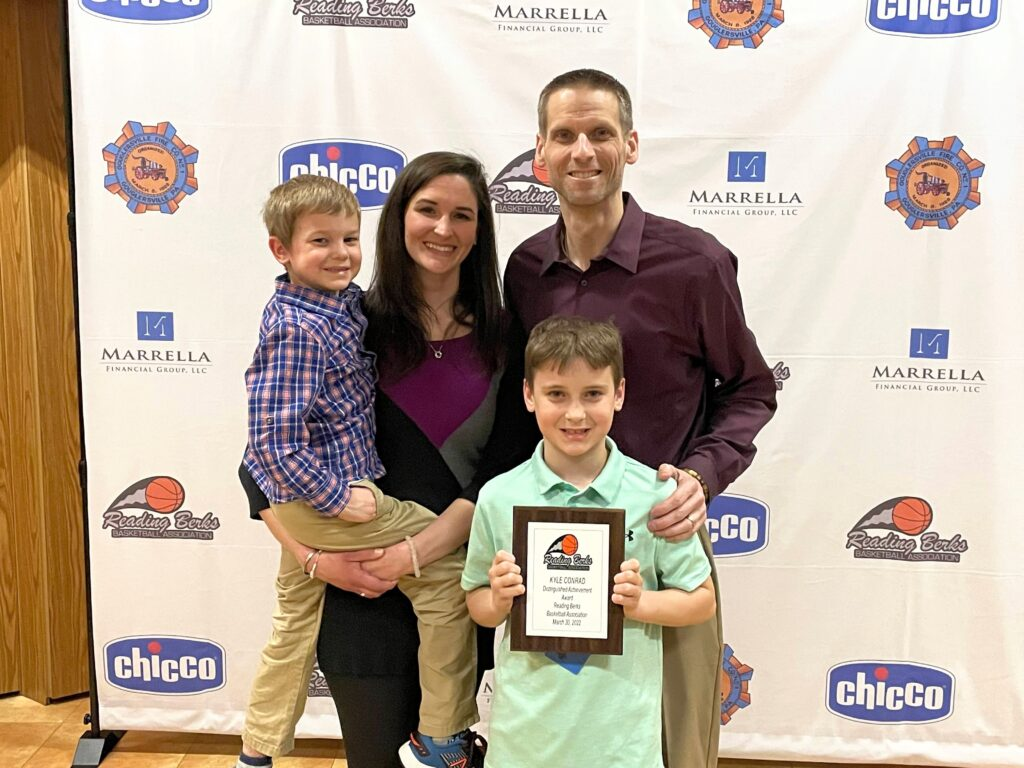
Kyle Conrad: ‘He’s always going to have a piece of every player’s heart’

The celebration of life ceremony for Kyle Conrad was thoughtfully designed to allow those who knew him to feel better about his passing.
After listening to the people who knew him best I miss him more than ever.
I knew him as a Gov. Mifflin basketball player and coach, a fierce competitor, a winner, an inspirational leader of young men and a courageous fighter who battled cancer for years.
I didn’t know he secretly wanted to be Sylvestor Stallone’s cornerman, that he and some college basketball teammates had a club band or that he could quote random movie lines as if he had written the scripts.
“I didn’t know he could sing,” said one former Mustangs basketball player, among those who packed the gym at Gov. Mifflin Intermediate Saturday afternoon for a stirring 90-minute remembrance.
To those who didn’t know him well Kyle could be quiet and unassuming; to those in his inner circle he was anything but. He loved to laugh and sing and share; he loved to compete and win. His closest friends, teammates and family members adored him for it.
As someone once said about Frank Sinatra, Humphrey Bogart and James Bond: “Women wanted to be with him and men wanted to be him.”
Conrad was a three-sport athlete at Mifflin, playing soccer and baseball along with basketball, but got along with everyone.
“Hundreds of us considered him our best friend,” said classmate Colin Waszkiewicz. “He was always there to say the right things.”
Waszkiewicz was a wrestler; he was in a different orbit than Conrad and the basketball players. Yet they bonded and became lifelong friends.
That speaks volumes.
“Teachers adored him, because he always did the right thing,” recalled classmate Alison Tannous.
Being respected by both your classmates and your teachers is a tightrope only the most skilled can manage, but that was part of Conrad’s magic. He checked all the boxes.
“Kyle was a complete athlete, a complete person,” said his basketball coach at Mifflin, Dave Argentati.
Conrad loved to sing and joined the school choir. He didn’t care that it wouldn’t look cool for a star athlete; he turned that stereotype on its ear.
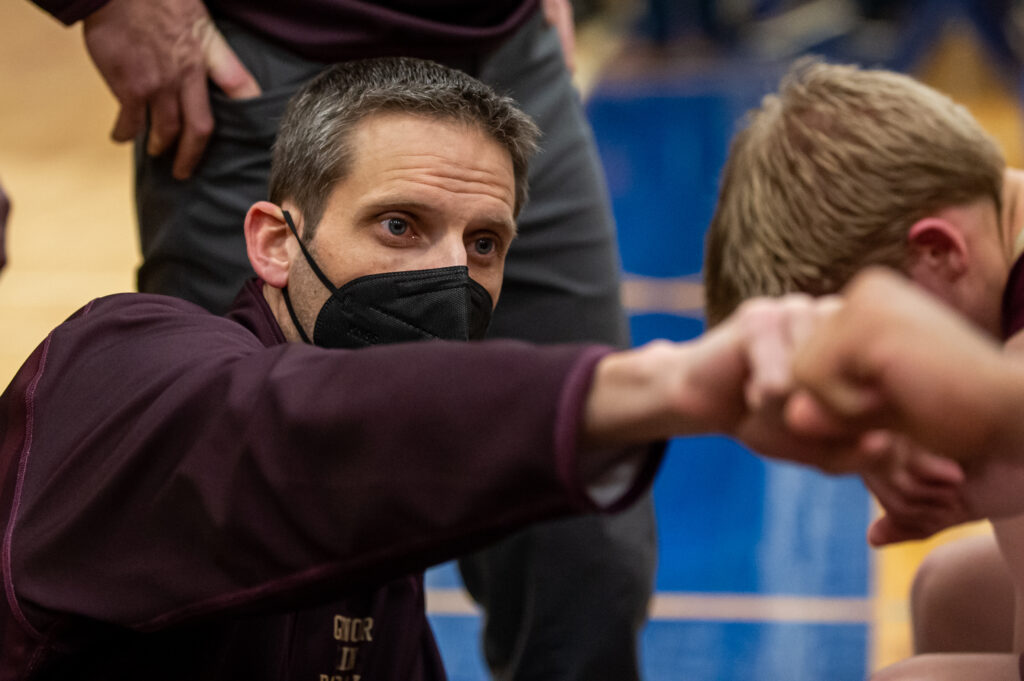
“Kyle made singing in the school choir cool,” Waszkiewicz said.
As skilled as he was on the basketball court, the greatest impression Conrad made during his college days at Elizabethtown was as the ultimate teammate.
Why else would some two dozen former Elizabethtown players, now scattered across the country, show up in Shillington wearing Blue Jays T-shirts, all with Conrad’s No. 21 on the back?
Barry Acker, the Elizabethtown assistant coach during Conrad’s four years at the school — among the best the program has ever known — could barely speak when it was his turn, he was so overcome with emotion and love.
When Conrad succumbed to cancer early last month after an arduous three-year battle, word spread quickly throughout the Blue Jays basketball family. The very next day a dozen or more former players and coaches gathered at a friend’s house to laugh and cry and remember the good times: The close games, the bus rides, the national championship run, the parties, the late nights.
“Kyle was an inspiration for all of us,” said Bob Schlosser, Conrad’s coach at Elizabethtown.
He looked over to several rows of guys who played with Conrad more than a decade ago.
“People always said the Blue Jays family remains close because we won,” he said, talking about conference titles and a trip to the NCAA Division III championship game. “No. We won because we were close. We are a family.”
Unlike the others who spoke Saturday Matt Coldren was never particularly close to Conrad. They competed against each other — fiercely at times — in local summer leagues. Later, when they became head coaches — Coldren at rival Wilson — they continued their battles. Soon they became respected combatants.
It wasn’t until Conrad became ill that they grew close.
Coldren went through cancer travails of of his own; he lost both parents to it in recent years. When Conrad was diagnosed Coldren made it a point to reach out to help. Turns out Conrad helped him more.
“Kyle opened up his heart and his mind to me,” Coldren said.
They shared stories and concerns and Coldren — like most who interacted with Conrad — came out the better for it.
“He taught us what true strength and courage look like,” Coldren said, “and about the power of love. He helped me get over the loss of my mother and father. We were good for each other.”
“He always (told the players) it’s not over till it’s over,” said Brian Wrobel, Conrad’s assistant coach at Mifflin. “He would say: ‘I’m gonna keep pushing and put everything I have into it,’ and that’s what he did.
“I hope he knows it’s never going to be over. He’s always going to have a piece of every player’s heart, of everyone he touched.”