



There was no blocking Chuck Brice’s ascent to college football greatness
2026 Berks football coverage presented by
Utilities Employees Credit Union

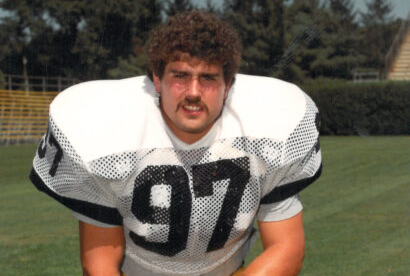
Chuck Brice was such a swift linebacker at Holy Name that he drew the attention of coaches at Villanova University, earning a scholarship.
He was a dominant force for the Blue Jays, earning All-Berks honors at two positions and helping them win back-to-back Inter-County League championships in 1979 and 1980.
“He couldn’t be blocked,” recalls Rick Keeley, a Holy Name assistant coach at the time.
Brice never got the chance to play at Villanova: A few months before he headed to the Main Line university officials shut down the football program due to financial constraints.
| Class of 2026 | |
| Gooch Adams | Wilson |
| Dave Bodolus | Daniel Boone |
| Chuck Brice | Holy Name |
| Pete Gilmore | Wilson |
| Nate Romig | Daniel Boone |
| Dr. Randy Yocum | Sch. Valley |
Brice was stunned.
“It was a really hard time in my life,” he recalls.
He had no idea the heights he would soon attain or the honors which awaited him, the most recent being his induction into the Berks County Football Coaches Association Hall of Fame on June 6, along with Gooch Adams, Dave Bodolus, Pete Gilmore, Nate Romig, and Dr. Randy Yocum.
Brice’s football career was in limbo in the days leading up to graduation from Holy Name; it was a time before the Internet, in an era when college recruiting was done in person, and largely by word of mouth.
After having the rug pulled out from under him Brice didn’t have the resources, nor the time, to re-start his recruiting process.
He caught a break when coaches from the University of Delaware reached out with an offer to send him to Fork Union Military Academy for a year. Unbeknownst to Brice it turned out to be a game-changer.
“I had no idea where I was going,” he says the school located in rural Virgina, west of Richmond. “I didn’t realize the caliber of football I was getting involved with. Probably in my life, it’s one of the best things I ever did.”
Brice played with and against future Division I and NFL players. Fork Union’s quarterback at the time was future Heisman Trophy winner Vinnie Testaverde. Its schedule included JV teams from Penn State, the University of Virginia, Virginia Tech, Navy, N.C. State and the University of North Carolina.
That prepared him to step onto the field at Delaware in 1982 — but not before another curveball was thrown his way.
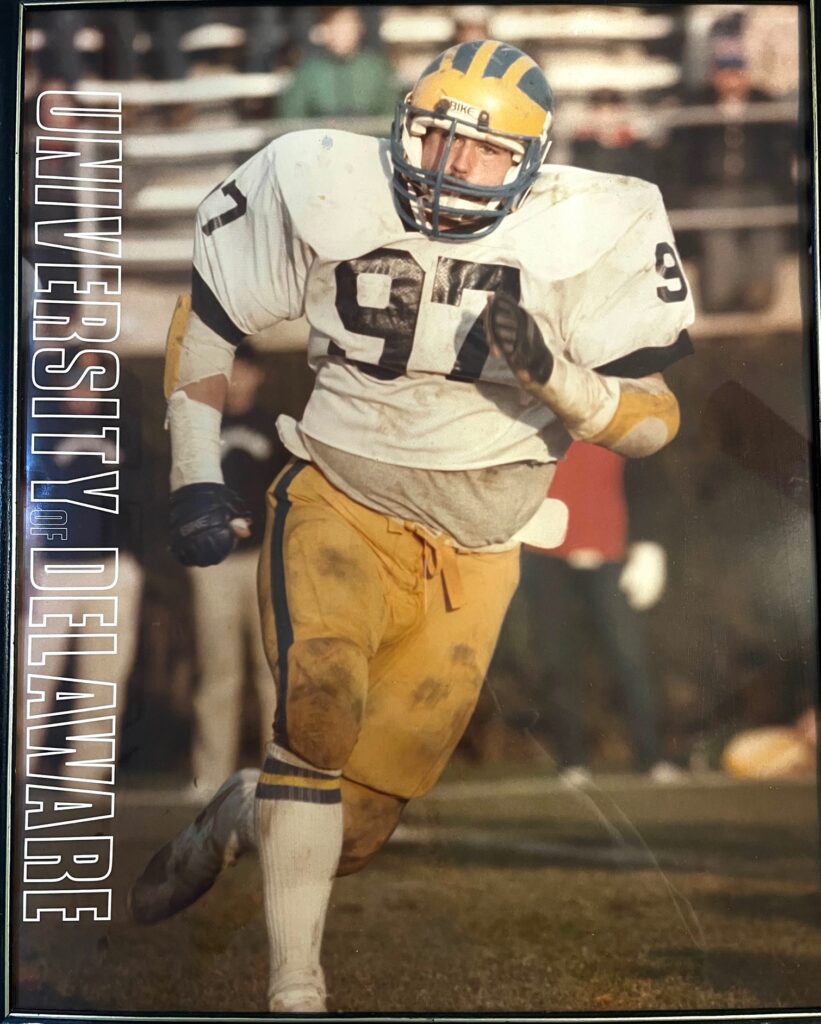
“The coaches wanted to get me on the field (right away) so they moved me to defensive end,” said the then 6-1, 225-pound Brice. “I absolutely hated it. For the first time in my life, I was away from the action.”
Before camp concluded he was moved inside to tackle, due to injuries on the line. He was several inches shorter and 50-60 pounds lighter than they guys he was lining up against. Didn’t matter. By the Blue Hens’ second game he was in the starting lineup and stayed for the next three seasons.
Despite being out-sized Brice excelled because of his athleticism and quickness.
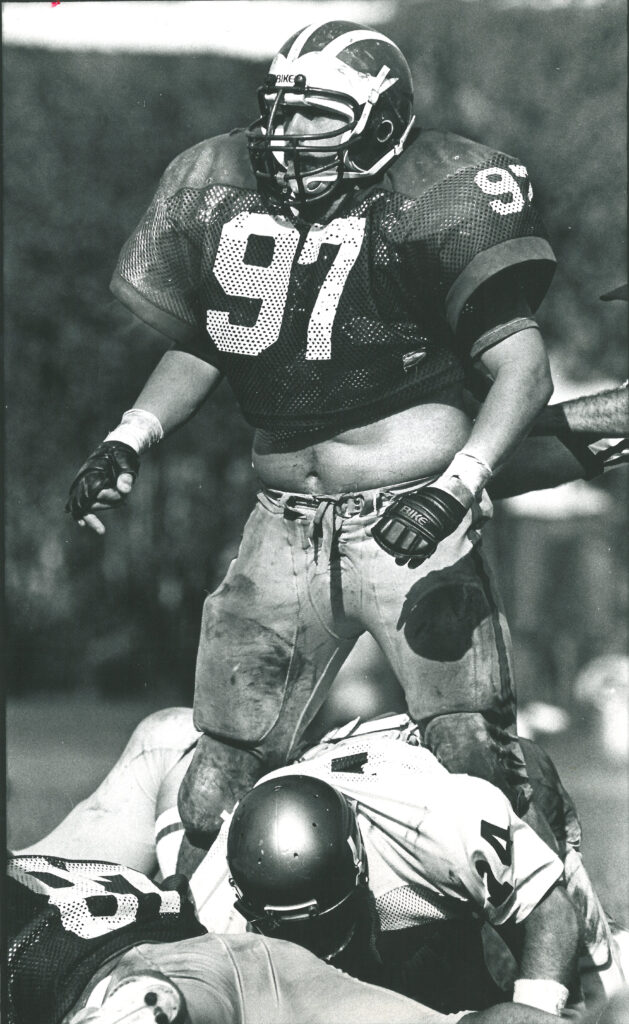
“He had such good feet,” says Keeley, who coached him on the offensive line at Holy Name. “He could move sideline to sideline; he had speed that not many kids that big had. He was just devastating.”
Brice recorded seven sacks and was third on the team in tackles as a sophomore. He led the team with nine sacks and was second in tackles as a junior when Delaware – with Rich Gannon at quarterback — finished 8-3.
He survived in the trenches because of his work in the weight room, where he became one of the strongest players on the team.
“I learned to be quick and low,” said Brice, who was up to 265 pounds as a senior. “I focused on lower-body strength. My advantage was leverage; I had to be below everybody.
“I was playing against legit guys, (future) long-time pros. To be in the middle of the line like that you needed to learn to stay low and have complete lower-leverage body strength. I had to be quick enough to get around ’em, because I was not gonna go toe-to-toe with any of them.”
Brice was an all-ECAC first team pick and named Delaware’s Outstanding Defensive Player as a senior in 1985. He left with the program record for career sacks, as a honorable mention All-American, and with ambitions of a pro career. Banged-up knees – he’s undergone 13 operations – curtailed his NFL dream.
His impact at Delaware was unquestioned: He was named to the program’s All Century-Team and was voted as one of the top 100 players.
Years earlier Brice overpowered his I-C competition because of his physical prowess. He once won a game at Daniel Boone when he stormed the line in the final minute of a scoreless battle and blocked a punt. The ball rolled out of the end zone for a safety and the Blue Jays won 2-0.
“Chuck was a force,” recalls Keeley. “We moved him (from defensive line) to linebacker (for his junior season), and he was just devastating. You give that guy a running start coming into the offensive linemen . . . look out!”
Brice credits former Blue Jays assistant coach Dave Booth for aiding his defensive development. They worked together in the summer one-on-one, even after Booth left Holy Name to become Boone’s head coach.
“He taught me how to read plays and react,” Brice recalls. “That really helped me throughout my career.”
Brice repaid his former freshman coach with a Pick-Six and a blocked punt in a win over the Blazers in 1979, then the game-winning blocked punt a year later. The Blue Jays won nine times in each of those seasons.
“We won a lot of games because we played great defense,” Keeley recalls. “And Chuck was a big reason for that.”
The biggest of those wins came in Brice’s final high school game, a 14-8 victory over rival Central Catholic that clinched the I-C title. More than the details of the game he recalls the “sea of people” he and his teammates encountered as they left their locker room and made their way onto the field at Central Catholic Stadium in St. Lawrence.
“That was what Central Catholic-Holy Name should’ve been all the time,” Brice recalls. “It was pretty much a slugfest.”