



The top Berks girls program of 2021-22? It’s not even close

Last week, when introducing the “Berks Cup” as a way of ranking the top Berks County athletic programs, it was mentioned that the 2021-22 season was hardly a banner one for Berks boys.
Not the case for Berks girls.
Thirteen girls teams — from 10 different schools — won District 3 championships; another 12 were a district runner-up. Four teams reached a state final; Twin Valley won a PIAA championship in field hockey.
The Berks Cup idea is modeled after those used by many college conferences, and after the NACDA Directors’ Cup, which ranks the top programs based on league standings, championships and national rankings.
| Berks girls champs | |
| Basketball | Gov. Mifflin |
| Bowling | Gov. Mifflin |
| Cross country | Exeter |
| Field hockey | Twin Valley |
| Lacrosse | Twin Valley |
| Soccer | Wilson |
| Softball | Exeter |
| Swimming | Wilson |
| Tennis | Conrad Weiser |
| Track & Field | Wilson |
| Volleyball | Wilson |
Heading into the spring season Michigan, Notre Dame, Ohio State and Stanford were the national leaders.
So what would a Directors’ Cup-style breakdown of Berks girls programs look like for the now-completed 2021-22 school year?
It would look like a Twin Valley runaway.
The Raiders won a pair of Berks championships, in field hockey and lacrosse; a pair of District 3 titles, in the same sports; and saw each of those teams reach a PIAA championship game.
Twin Valley piled up 215 points, 47 more than runner-up Wilson and 81 more than third-place Wyomissing.
Teams were awarded points for division championships (three), making the Berks playoffs (one additional point) and reaching or winning a league championship game (five or 10 points, respectively).
For district competition the points were doubled: 10 for reaching a district final, 20 for winning a title. Also, two points were awarded for each victory in district competition up to the finals (but not including play-back or consolation rounds).
For the PIAA Tournament the points were increased again: four for qualifying, four for winning a game (up to the championship). Fifteen points were awarded for reaching a state final, 30 for winning one.
Not every sport fits into a cookie-cutter style playoff system. In swimming, for example, there is no league tournament, just a regular season champ. In bowling there are no district or state team tournaments.
For track and field additional points were awarded for a Top 5 or Top 10 finish at the district and state meets.
(Water polo was not included because only five Berks schools compete.)
Individual winners, in sports such as tennis, swimming and diving, wrestling, and track and field, were not factored in; only team events were used.
Finally, the schools were split into size classifications: The 10 largest Berks schools fall into the Big School category, the eight smallest into the Small School.
Twin Valley finished first on the strength of its two state finalists, which collected more Berks Cup points than any other teams. The field hockey team, which finished 27-2 and went 11-0 in the postseason, finished with 88 Berks Cup points. The lacrosse team, which finished 25-2 and won 22 straight games before falling to Archbishop Carroll in the Class 2A state championship game, finished with 71 Berks Cup points.
Several players had prominent roles on both teams, including Emma Winther — an All-Berks pick in both sports — Hadley Munn and Kylie Duke. Natali Foster, Anna Kaplan, Rachel Knight and Collete Lennon were top players on the Raiders’ division-winning basketball team as well as one of the other district championship teams.
Twin Valley sent five teams to the PIAA Tournament, including volleyball, basketball and softball. The Raiders won division championships in field hockey, basketball, lacrosse and track and field; Berks Catholic was the only other program to win four division titles (the Saints won them in cross country, volleyball, basketball and softball).

Wilson had more league finalists (six), more league champs (four), more District 3 qualifiers (seven) and more PIAA qualifiers (six) than any school. Nine different Wilson teams scored Berks Cup points, more than any school except Mifflin, which also had nine.
The Bulldogs won league championships in soccer, volleyball, swimming and track and field. They qualified for the PIAA Tournament in field hockey, soccer, volleyball, swimming and lacrosse, and finished fifth in track and field.
Gov. Mifflin, which finished third in the Big School division with 96 points, had a pair of county championships, in basketball and bowling, and three league finalists.
Wyomissing was the Small School champ, with 134 points, third-most overall. The Spartans produced three District 3 champs — more than other Berks program — winning in soccer, cross country and track and field; their tennis team was a district runner-up.
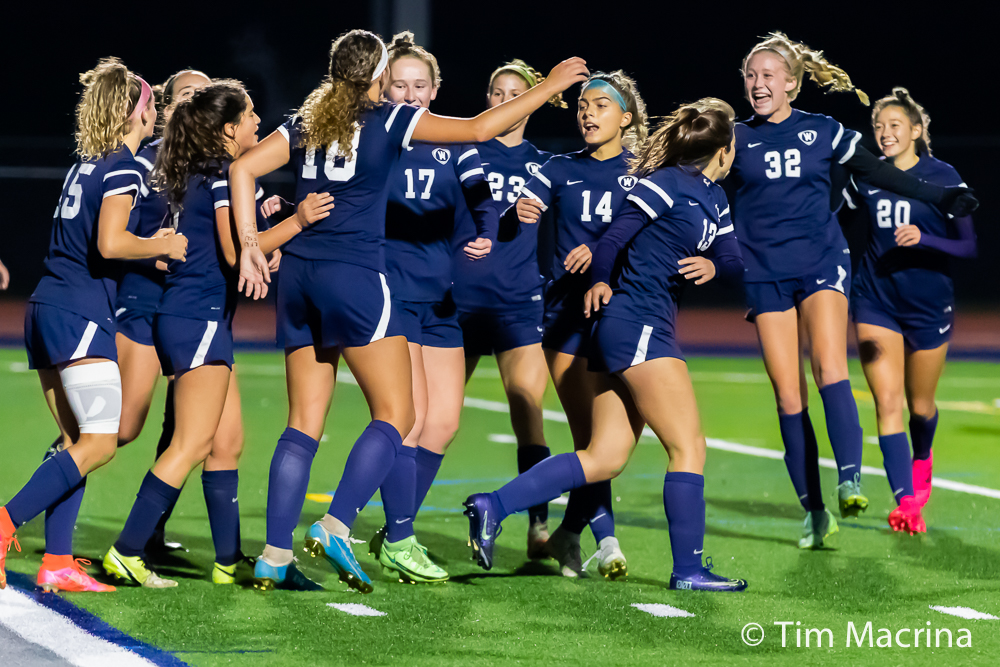
Oley Valley finished second in the Small School division with 70 points, largely on the strength of its field hockey team, which finished with 66 Berks Cup points — third-most overall. The Lynx won division and district titles and reached the PIAA championship game in hockey.
Conrad Weiser’s tennis team, which won Berks and district titles, was the fourth-highest scoring team, with 52 points. Exeter’s softball team, which won division, league and district titles, was next, with 50 points.
Reading High, Berks’ largest school, scored just one point, by reaching the basketball playoffs. Antietam, the Berks League’s smallest school, did not reach the playoffs or have a winning record in any sport.
| Big School | Small school | |||
| Twin Valley | 215 | Wyomissing | 134 | |
| Wilson | 168 | Oley Valley | 70 | |
| Gov. Mifflin | 96 | Brandywine Heights | 54 | |
| Exeter | 93 | Schuylkill Valley | 52 | |
| Conrad Weiser | 76 | Hamburg | 43 | |
| Berks Catholic | 55 | Kutztown | 42 | |
| Fleetwood | 28 | Tulpehocken | 18 | |
| Muhlenberg | 26 | Antietam | 0 | |
| Daniel Boone | 24 | |||
| Reading High | 1 |


