The I-C’s last run

The Inter-County League, entering its final season, has a storied history.
(With 13 Berks teams set to join Wilson in the Lancaster-Lebanon League beginning Friday, here’s a look back at a story posted in Aug. 2021 about the end of an era in Berks County football.)
The Inter-County League has come a long, long way since its inception in the late 1950’s.
It was born as an outlet for small schools with struggling programs seeking an even playing field, and it included just two Berks teams.
Some seven decades later what’s now known as the Berks Football League approaches its 65th and final season with a rich history, a Berks-only roster of schools and with some powerhouse programs.
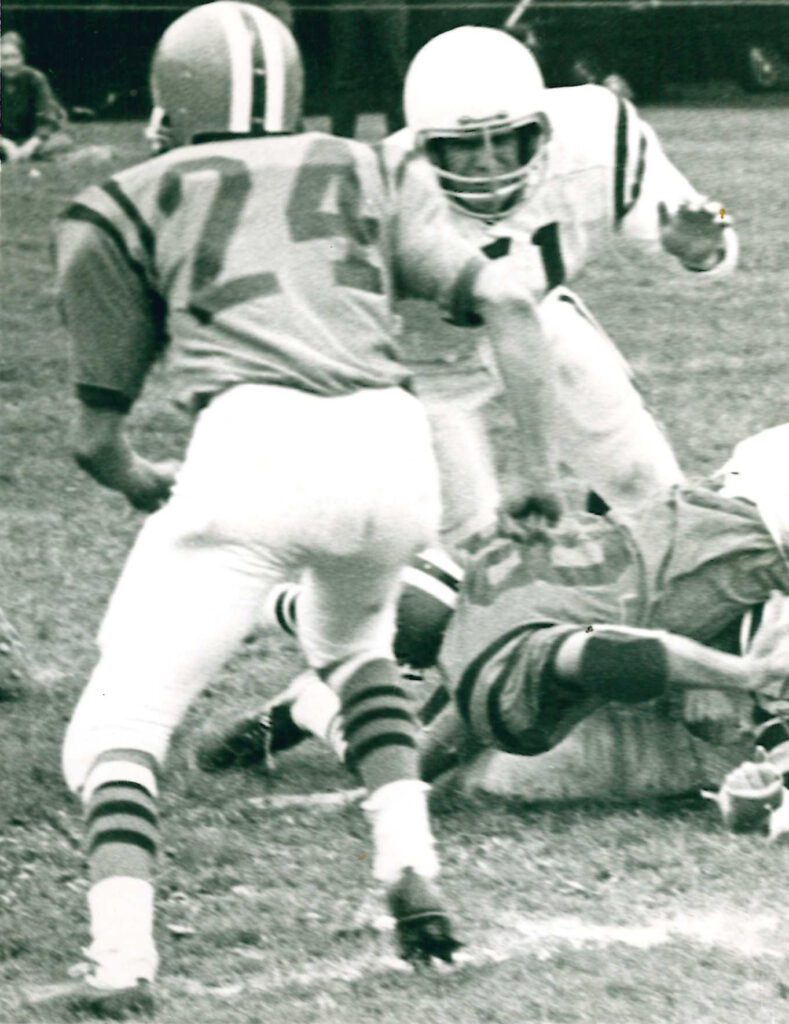
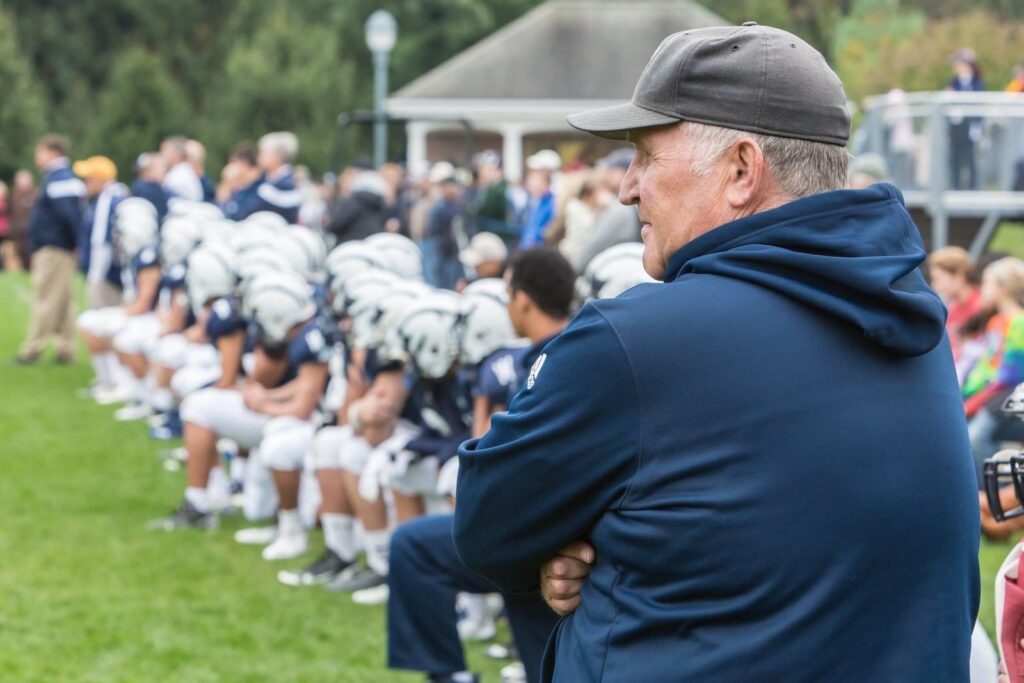
“There were always a lot of good people in the I-C,” said long-time Wyomissing coach Bob Wolfrum, who has coached in the league since 1974. “You (always) knew you were playing against classy guys.”
The I-C, as it’s still fondly called by many (despite a long series of name changes), has always been known as much for its spirit of sportsmanship and community as it has for its spirited local rivalries: Central Catholic vs. Holy Name, Holy Name vs. Wyomissing, Muhlenberg vs. Wyomissing, Exeter vs. Daniel Boone, Hamburg vs. Schuylkill Valley, and most recently Berks Catholic vs. Wyomissing.
I-C games will officially come to an end in late October; next season the league’s 13 teams will join Wilson as part of the mega-sized 37-team Lancaster-Lebanon League.
The new league will ease scheduling concerns, give smaller programs competition better suited to their level, and should improve competitiveness across the board, long a problem in an I-C landscape that’s seen programs at Wyomissing, Berks Catholic and Gov. Mifflin pull away from the competition.
Of course with that change the league will lose its identity. Much of the “local” feel of the I-C will be gone and some of the league’s traditions will fade into the pages of history.
The I-C has come full circle since its debut in 1957. Wyomissing High and West Reading were the lone Berks members in the eight-team circuit populated by small Montgomery County schools such as Lower Moreland, Jenkintown and Schwenksville.
The programs were mostly strapped for numbers, with rosters in the 20’s, sometimes less.
Most of the games in the early years were played on Saturday afternoons as none of the schools had lighted stadiums. (Collegevile-Trappe sometimes brought in portable lighting.)
None of the charter members – including Collegeville-Trappe, Pottsgrove and Upper Dublin – remain in their original form. They disappeared from the landscape, as did Wyomissing High and West Reading, which merged to form Wyomissing Area in 1968.
All told 29 different schools have called the league home at various times; nearly 2,500 league games have been played.
Collegeville-Trappe won the league’s inaugural title and remained strong throughout the early years, adding titles in 1958 and 1965. It left the league following the 1968 season with a .716 league winning percentage, the best in the league at the time.
The Wyomissing Warriors emerged as the first dominant team, winning three of the first four titles, including unbeaten seasons in 1959 and 1960. The Warriors’ prolific offense put up scoring numbers unheard of in that era, averaging 41.0 points per game in 1959. That mark wasn’t topped for 42 seasons.
The Montgomery County schools began to out-grow the league and one by one started to peel away, to join leagues closer to home, and that could offer better competition.
Lower Moreland and Upper Dublin left after the 1964 season to join the Buxmont League, and Pottsgrove headed to the Ches-Mont. In 1965 Jenkintown left to join the Bicentennial League and Bridgeport became part of the merger that former Upper Merion.
The league was in peril at that point, with just six teams. Without better options, Daniel Boone and Exeter played each other twice during 1966 and 1967 seasons.
The league was bolstered in 1968 when new programs at Holy Name and Schuylkill Valley were added and Lansdale Catholic joined.
In the 1960s some of the Berks schools – Conrad Weiser, Daniel Boone, Exeter, Holy Name and Schuylkill Valley – used Reading Municipal Stadium, home of the Reading Phillies, as their home field.
Playing there made for lasting memories.
“That was a big thing to go in there to get to play at night,” Wolfrum said.
“It was neat,” said Berks Catholic’s Rick Keeley, who played at Municipal Stadium during his days at St. Pius X and coached there with Holy Name. “We got mouthfuls of dirt when we were mixing it up in the infield.”
Bill Sakusky, the late Hamburg coach, remembered playing a game at the stadium the week after the circus had pulled out – and after the elephants and horses had left their marks.
“Your kids had to get (tetanus) shots before you were allowed to played on the field,” he said.
Holy Name made history by winning the league championship in its first season, 1968 – a rather incredible feat considering how many other programs have struggled to get off the ground during their early years. The Blue Jays won it the next year, too.
Central Catholic matched that feat by winning the I-C championship in its first season in the league, 1971, after coming over from the Tri-County League. The Cardinals beat Holy Name 7-6 in the season finale, scoring in the final minute. That ignited one of the greatest rivalries in league history.
The Cards’ and Blue Jays’ season-ending “Holy War” was the biggest game in town for years.
“That (game) was it, make or break” Central Catholic coach Vince Shemanski once told the Reading Eagle, “that made our season if we beat them.”
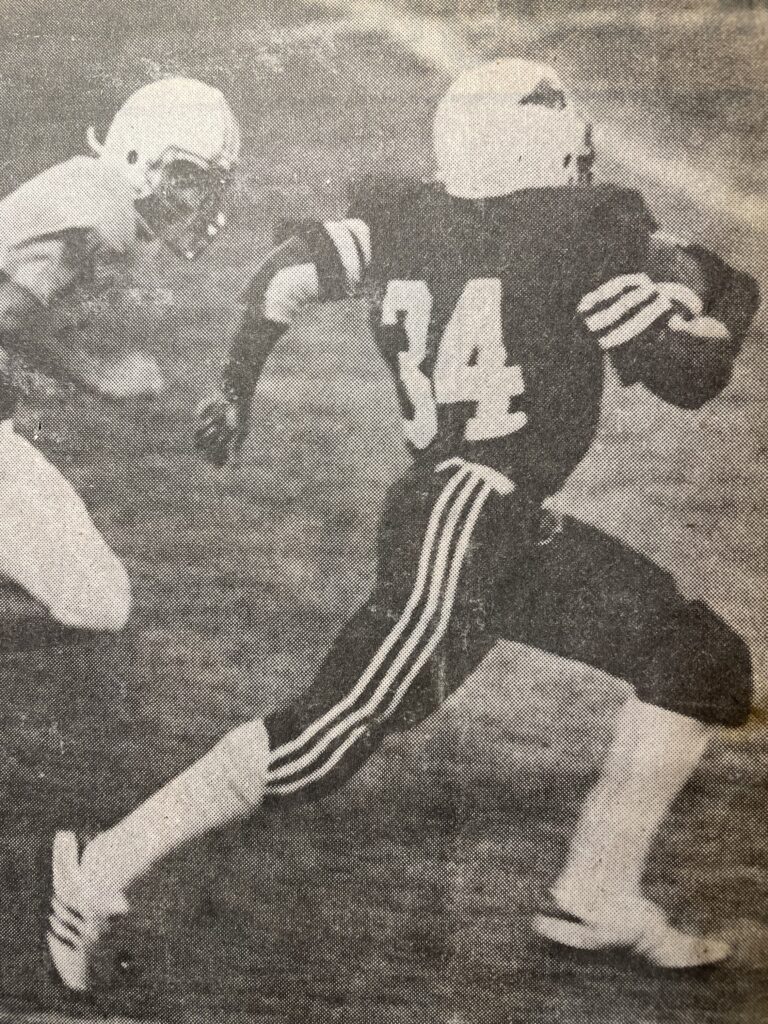
No game in league history was bigger than the 1975 final clash between the Cardinals and Blue Jays, each of which were unbeaten. They drew a reported crowd of 10,000 to Municipal Stadium. Holy Name tied it on Scott Hettinger’s 88-yard, third-quarter kickoff return and scored the deciding points in the 14-12 victory on Tom O’Neill’s two-point conversion pass to Pete Gipprich.
“It was a tough one to swallow,” said Shemanski after being denied his 100th victory in his final game, “very difficult.”
The Blue Jays won eight titles in their first 13 seasons and the Cardinals were right there with them most seasons, the battle for the Campbell Cup often determining the league champ.
When Lansdale Catholic joined the mix the three parochial schools controlled the league. Over a 13-year period, from 1968-80, they combined to take 11 titles.
The 1980s saw Conrad Weiser, coached by former Syracuse quarterback Ferdie Kuczala, emerge, with back-to-back unbeaten runs through the league in 1981-82 – just the second team to accomplish that.
Wyomissing’s prowess also began to grow. The Spartans finally broke the parochial stranglehold in 1984 to claim their first title. Wyo also won titles in 1986 and 1989 and had the highest league winning percentage (.767) of any team in the 1980s.
Central Catholic’s David Gilmore provided the most dominating performance in league history when he ran for six touchdowns – most in I-C history – and set the Berks single-game rushing mark with 356 yards in a 56-28 win over Wyomissing in 1983.
Gilmore and the Cards went on to become Berks’ first District 3 champ that season.
Balance was a trademark of the league through its early decades. There were often ties for first place and games among the top contenders were often close – and unpredictable.
(Photo courtesy Wyomissing Area athletic department.)
“I still remember the first year we won the league championship, Kutztown beat the hell out of us,” Wolfrum said. “They beat us 22-0 and it was like men against boys. That (sort of thing) could happen from top to bottom in the league.”
By 1981, after Lansdale Catholic departed, it was an all-Berks league, and remained that way until 2004, when Blue Mountain and Pottsville joined.
John Yocum’s Muhlenberg program earned the distinction of Team of the 90’s, claiming six titles and winning 88 percent of its league games during the decade. The Muhls’ 1992 and 1998 teams are among the most dominant in league history.
Wyomissing wasn’t far behind and its annual meetings with the Muhls were epic.
The greatest finish in league history might’ve come in 1993 when Conrad Weiser beat Wyomissing 21-14 at the A-Field to force a three-way tie between those two teams and Muhlenberg. Many of the Muhls’ players, who had won the night before, were among the throng that surrounded the A-Field, and they celebrated as much as the Scouts.
The league’s heydey may have come during the early 2000’s, after Gov. Mifflin came over from the Lancaster Lebanon League and Blue Mountain and Pottsville joined from the Schuylkill League. Section 1 games became knock-down, drag-out fights, as most of the programs were at their peak.
Pottsville, under head coach Kevin Keating, had 13-win seasons in 2005 and 2006 and reached the PIAA Class 3A championship game both years. And yet the best the Crimson Tide could do was share the 2005 title with Muhlenbreg.
Daniel Boone hit new heights under head coach Dave Bodolus and shared section titles in 2006 and 2010.
Section 1 was so balanced that five times between 2004 and 2010 there was a tie for first place; twice there was a three-way tie.
That balance has been blown apart in recent years by emergence Mifflin’s program; Berks Catholic and Wyomissing also distanced themselves from the other Section 2 programs.
The Mustangs enter their final season in the league with a .902 winning percentage over 17 seasons, and with 11 Section 1 titles over the past 14 years.
The Saints were formed in 2011 by the merger between Central and Holy Name and immediately became a state power, reaching the Class 3A semifinals three times in their first six seasons. They set Berks scoring records in 2015 and again in 2017.
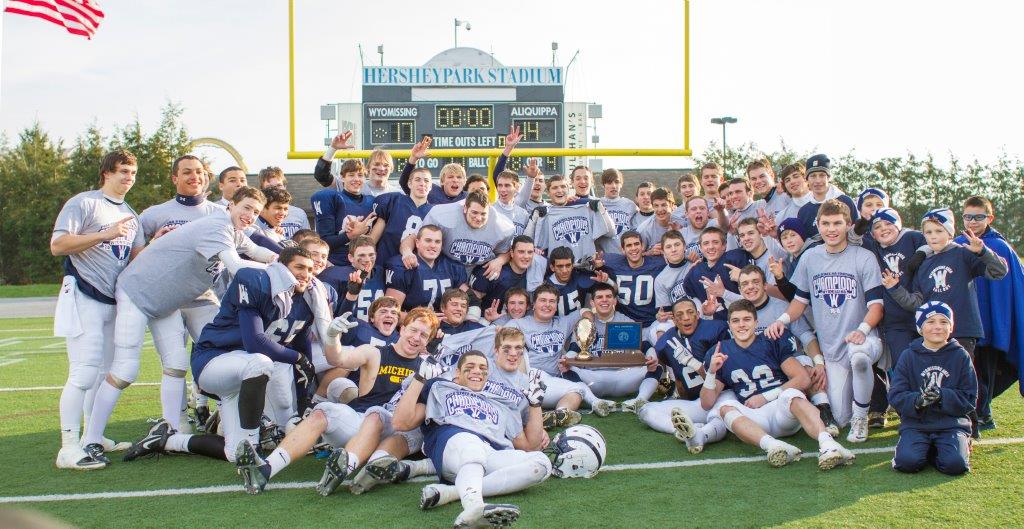
The Spartans became the first Berks team to record a 16-0 season and win a state title in 2012; they returned to the PIAA title game last season.
(Photo courtesy of Wyomissing Area athletic department.)
Wyomissing has more league wins than any other school, with 283; Exeter, which has been a league member longer than any other school, is next with 262 league wins.
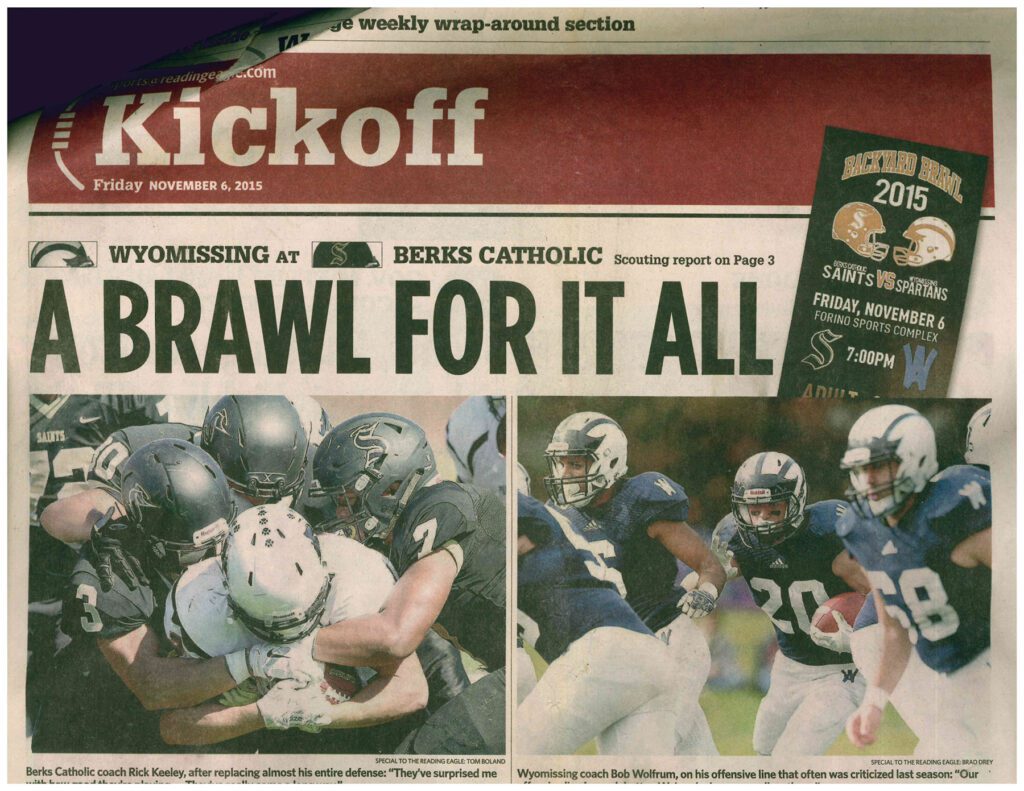
The “Backyard Brawl” between neighboring Berks Catholic and Wyomissing quickly became an institution and produced some of the most thrilling games in I-C history.
The Saints and Spartans will resume that rivalry next season when they’ll be paired the same section in the L-L.
The move to the L-L, of course, will signal an end to the oldest continuous scholastic football league in District 3 and one the oldest in Pennsylvania.
Come season’s end the I-C will leave behind a tremendous legacy.
“I loved the league,” the late Jim Algeo told the Reading Eagle in 2001. “I just thought it was a class league.”