



PIAA chief Bob Lombardi talks about transfer rules, battling COVID and a possible shot clock in basketball
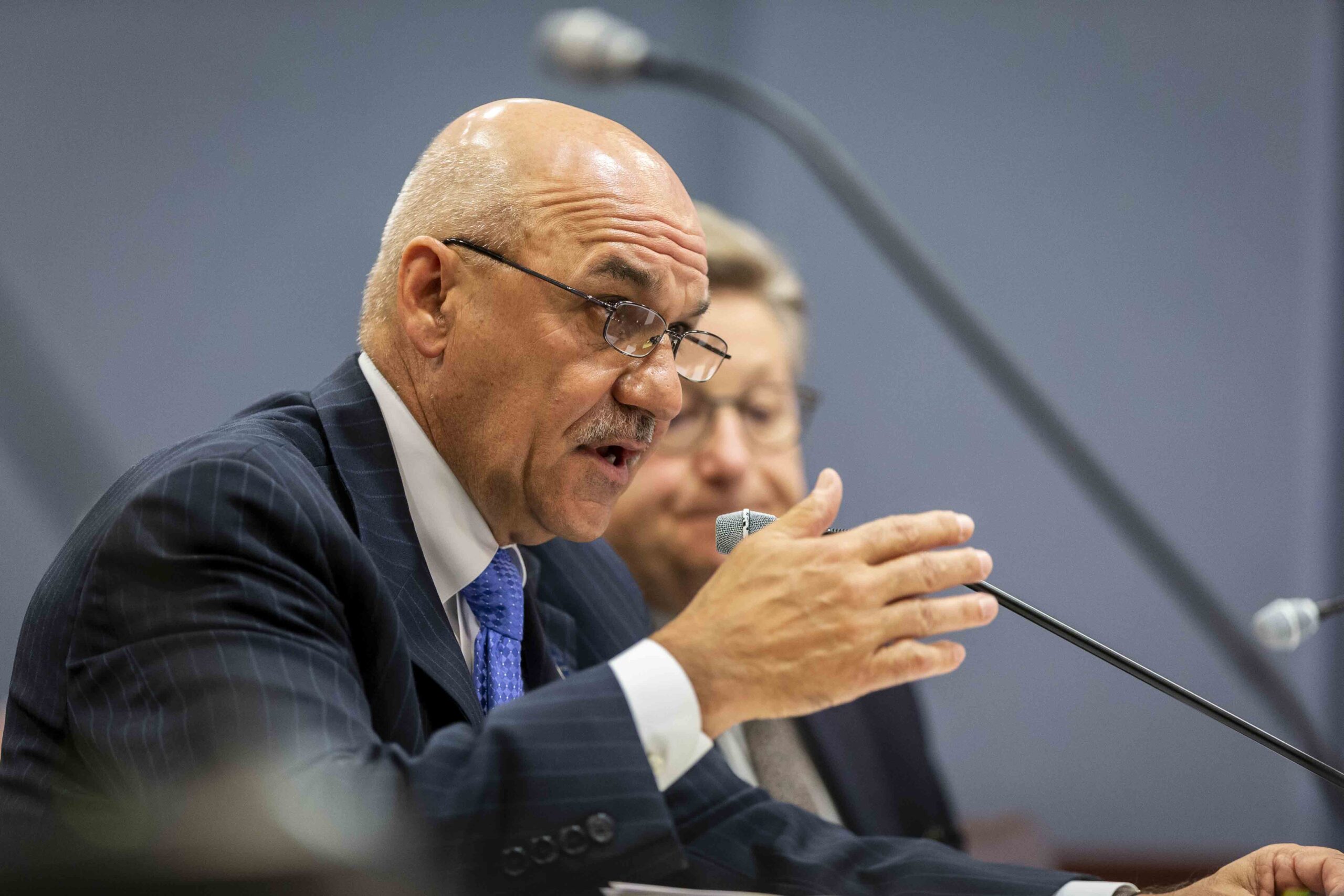
Dr. Robert Lombardi was named Executive Director of the Pennsylvania Interscholastic Athletic Association in 2012, and has worked for the state’s high school athletics governing body since 1988.
He has been the organization’s chief executive, or a top administrator, throughout a period of constant change — and often turbulence. Battles over the length of the football season, expanding to six classifications and the never-ending public/private debate have been hot issues during his time at the Mechanicsburg headquarters.

His most difficult challenge has come over the last 18 months, as the coronavirus spread throughout the Commonwealth and affected every facet of everyday life, including scholastic sports.
Through it all the 65-year-old northeastern Pennsylvania native has maintained an even keel and provided a steadying influence to the organization, even through the rockiest of times. He was a driving force last fall is seeing the PIAA push through with its sports calendar and crown state champions.
Along with that, he has provided a level of transparency heretofore unknown to the organization.
Lombardi has participated in high school sports from practically every side.
He played soccer, basketball, volleyball and baseball at Western Wayne High School, and played soccer at East Stroudsburg University.
He taught Health and Physical Education at Pocono Central Catholic High School for one year and in the Wayne Highlands school district for six years, and was a PIAA official for soccer and basketball. He earned a doctorate in sports administration from the University of New Mexico and worked for the New Mexico Athletic Association for two years before joining the PIAA in 1988.
MikeDragoSports.com recently spent time with Lombardi for a wide-ranging interview.
Q: About two years ago the long-simmering Public/Private issue boiled over, there was a constitutional convention of sorts, and some suggested that Public schools should leave the PIAA and start their own organization. That quieted down in a hurry and is barely mentioned now. What happened?
Some of those folks that were trying to light the fire had very little credibility. That’s the first thing. The second part of it is, we were in the process of completing our Competition Formula, and that has done exactly what we forecast it to do: It’s addressing those schools that have been successful and are taking transfers.
By moving them up in classification we have found that it has done exactly what we hoped it would, and we’re very satisfied at this time at what it’s addressed. There are a few tweaks we need to look at and we’ll continue to monitor that, because we believe it works. The feedback I’m getting is (people) like it.
Q: A key factor in the Competition Formula was tightening the transfer rules, and making student-athletes who switch schools after their 10th grade year ineligible for the postseason, right?
That postseason sit-out has really changed the landscape. This past school year we had 16 appeal hearings for postseason, and all 16 were upheld.
Q: Your sense is that once these rule went into place it curtailed a lot of potential transfers?
Yes, a lot of non-legitmate type transfers. If it’s a legitimate transfer, people get approved.
Q: There are no PIAA Board of Control meetings scheduled until September. Are you confident that you won’t have to be meeting on a monthly, or sometimes bi-monthly, basis as you did at this time last year when dealing with all of the COVID issues ?
We met in July, and we covered a lot of areas. Our sports medicine committee met, and they felt that as long as schools are adhering to their approved health and safety plans and following any guidance that would come out from the Department of Health, Department of Ed or the Governor’s office, we should be in good stead for this fall.
Q: I would imagine the 13-month stretch from March of 2020 to March of 2021 was certainly your most challenging time with the PIAA; what helped you get through that stressful period?
We met often, and kept lines of communication open with our districts and our Board members, as well as our sports medicine committee and other contacts. We were pretty well engaged. I met weekly with our surrounding states — Maryland, West Virginia, Virginia, D.C., Ohio, Kentucky — and that exchange of information was tremendously valuable in trying to navigate what was happening.
A large amount of the credit goes to the schools, the students, their coaches, their parents … they worked really, really hard to try to keep people safe.
In individual wrestling, we had 560 wrestlers in our postseason; no positive tests. Team wrestling: 400 wrestlers, no positive tests. Swimming: 728 swimmers, no positive tests. Diving, we had another 32; no positive tests. Basketball: 635 players, five positive tests. The total was 4,355 participants (and) five positive tests. That’s pretty impressive; the schools did that great of a job trying to keep people safe.
Q: Publicly, you remained even-keeled throughout that whole time; what was going on inside? How worried were you?
When that spring season (in 2020) went down, that was a gut punch. That was tough. Those students lost their spring season, and they can’t get it back. Athletic eligibility is one of those things you can’t get a do-over in. After four years you move on to the next chapter of your life. To lose a season was hard.
The best thing I had going for me was our tremendous staff. Everyone pulled in the same direction.
Q: Most people would say you’re generally conservative in your comments and actions, at least publicly, but with COVID you took an aggressive stance and went against the wishes of a lot of (influential) people, including Gov. Tom Wolf. What drove you in that direction?
The biggest mistake would’ve been if we didn’t try. The lesson we learned came the previous spring, on how devastating that was to those students. I believed with all my fiber, and everybody on our staff felt the same way, that we needed to take the opportunity to try, and if something went wrong we could shut it down. But we could take it day by day, minute by minute, in a systematic, step-by-step approach, evaluating as we went, and make decisions to keep people safe, and we did.
Some people didn’t like it. They tried to say we only cared about sports, but that wasn’t true. We cared about kids, and the mental aspects of those students, and how important it is to have that interaction between them and their classmates and teammates.
Q: How personally difficult was that decision for you, knowing this was a health issue, and that we didn’t have all the facts we needed at the time?
It was difficult, but we relied on our experts. Our sports medicine committee was unanimously behind that. And they were behind it because they knew the science. They work in our schools and work with student athletes every day, and they had their hand on the pulse. And their expertise was invaluable.
Q: Do you think your handling of the situation gained some newfound respect for the PIAA and helped the organization’s public image?
I think it illustrated to parents that we are committed to students; that we will work very hard to provide opportunities for them. I don’t know about the other piece (regarding a public relations boost), I hope so. I think we’ve always been approachable. Much like any type of organization it’s easier to criticize a nebulous group than get involved. I think we illustrated to the public that we’re engaged, and we know what we’re doing. I hope it was a positive.
Q: You don’t interject your personnel opinions into issues. Why is that? There’s nothing in the PIAA Constitution that says the Executive Director can’t voice opinions or steer the discussion when it comes to key issues.
I don’t think people want to hear my personal view. I have the responsibility to represent an organization that’s made up of 1,500 member schools, 325,000 participants, 11,000 sports officials, and everyone of them are valuable to us. The eighth kid on the field hockey team may be the next governor, who knows? Athletics are important to us, but also they should be fun, because they’re games. Games are to be fun. We don’t take that lightly. We want to represent them and give them the best opportunity that we can. It’s bigger than what I think.
Q: Once we’re through COVID-type issues and return to a full sense of normalcy what’s the next big issue PIAA faces?
There are a number of things, but one would be emerging sports that people want us to take jurisdiction (of), from ice hockey to water polo, girls wrestling, rugby, maybe even bowling. The health and safety of our athletes can never be put on the back burner. And then with this change you have at the next level, with Name, Image and Likeness, we’ll have to see how that pans out.
Q: The N.I.L issue is in effect only at the NCAA level; it doesn’t affect high school athletes.
Like anything else, that filters down. We’re concerned. We want to keep an eye on that to see how that pans out. We’re going to keep an eye on it.
Q: Many basketball fans across the state would like to see a shot clock. Where does the PIAA stand on that issue? Has that been discussed?
We’ve had some internal discussion. We’re going to meet with our basketball steering committee and knock that around, as well as our Board. We’re also waiting for the National Federation on some of the items that they need to amend, such as: There has to be a re-write of the rules (about) how to handle a shot clock. There’s a whole lot of rules in that NCAA rule book that addresses that. The other thing that’s concerning is that (some consider it) an unfunded mandate, that schools may have to purchase these (additional boards). What levels is it going to be (utilized) at? Varsity only? Junior varsity? All levels? We’re taking it in a measured approach.
Q: PIAA Tournament games in football, basketball and others sports last year were, for the first time, contested at home venues because of COVID-related issues. Will that continue in the 2021-22 seasons?
We haven’t made a final determination on that. We’re going to see what the landscape looks like. Last year, (some) schools were not (willing) to host two (outside) schools. I think that changed a little bit in the spring, because the (COVID) numbers went down, and people were getting vaccinated. But as you can tell with the landscape changing every day here, that’s a TBD.
Q: Will that decision be based on health concerns or economic concerns?
Health first. Economics would be under the concern of travel. We don’t want people running across the state, especially East to West. So, there is a little piece of economics in there. But it’s not a decision just to make money. That’s not it. It’s the economic concern of the school going to great expenses to travel a considerable distance.
Q: This is your 33rd year with the PIAA. You’re nearing retirement age. How much longer would you like to stay in this position?
I don’t have any plans at this time. It may be a bit. We’ll see. I’m just gonna take it year by year. If the Board accepts and likes what we’re doing, we’ll see. But my health is good. I like what I’m doing. I have great folks that I work with. I don’t have any scoop for you on that.
