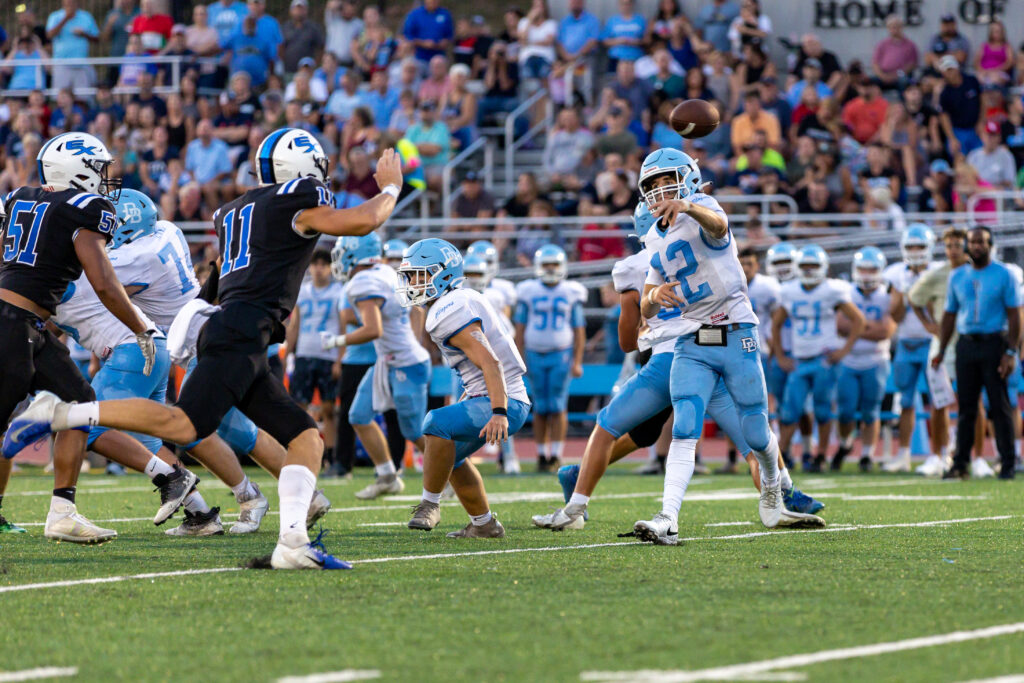
Exeter linebacker Lucas Palange: ‘I wouldn’t want to run against our defense’
It’s fitting that a historic goal-line stand clinched Exeter’s league championship and defined its perfect season because the Eagles are all about defense.
They have posted first-half shutouts in eight of 11 games — including the first seven — are ranked No. 1 in the Lancaster-Lebanon League in rushing defense, No. 2 in scoring defense and No. 3 in total defense. They’ve yet to give up a first-quarter touchdown.
“We all knew that our defense was going to be spectacular,” said senior defensive tackle Kyle Lash, a relentless force up front. “It wasn’t a surprise when we came out (in the season opener against Daniel Boone) and let up a big zero. We hit the field and we didn’t stop.”
The Eagles have one of the highest-scoring teams in the league, one the L-L’s most accurate passers and in Joey Schlaffer the most productive receiver in program history. Yet it’s defense that sets this team apart.
If this is indeed the best Exeter football team of all-time — it can become the first to win 12 games by beating Northern Friday in a District 3 Class 5A semifinal — it’s because this may be one of the sturdiest defensive units the Eagles have ever assembled.
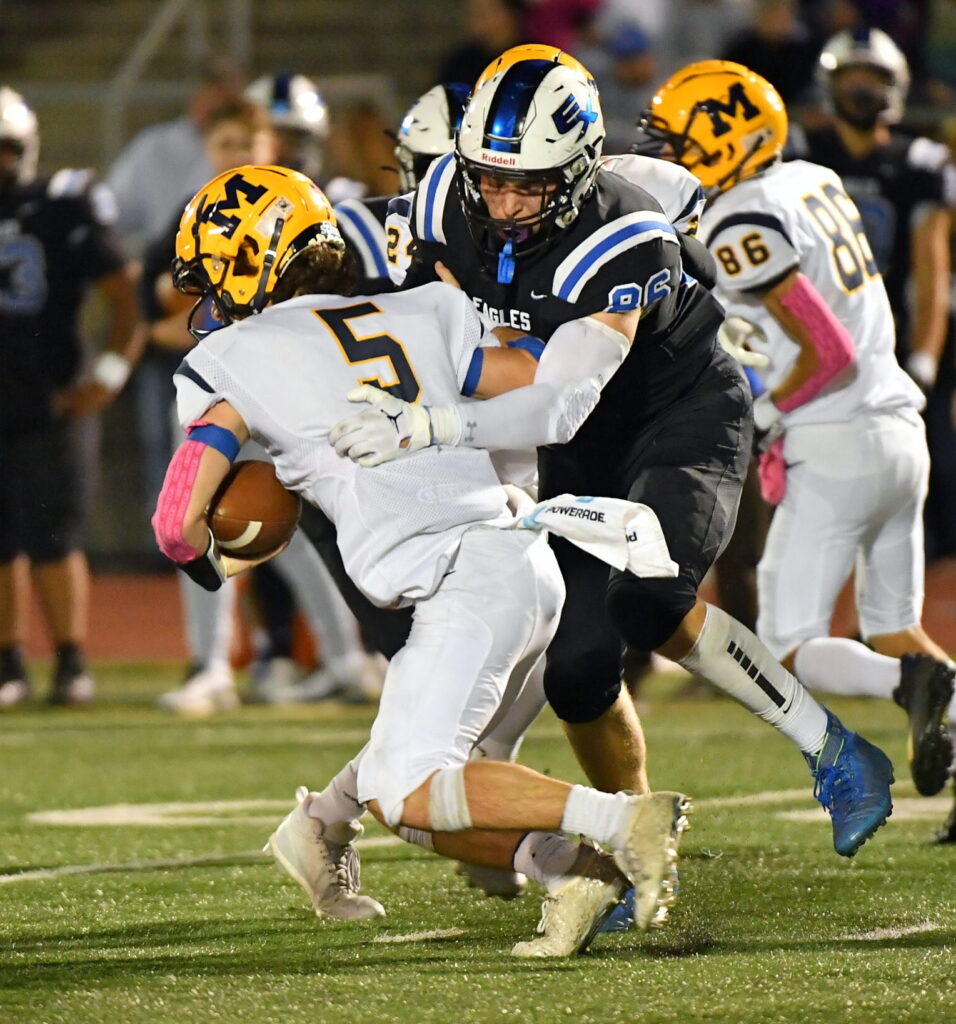
It held Section 1 champ Hempfield to one first-half score and negative rushing yards in a 44-22 Week 8 win. It held the highest-scoring team in District 3, Manheim Central, nearly 36 points below its scoring average and shut it out over the final 30 minutes.
And then there was that dramatic game-ending stand at Manheim after the Barons earned a first down at the 2, trailing 21-17 with little more than a minute left. All the Eagles did was throw the Barons for losses on the first two downs, then get a third-down interception from Nate Pashley to claim the Section 2 title and the No. 2 seed in the district tournament.
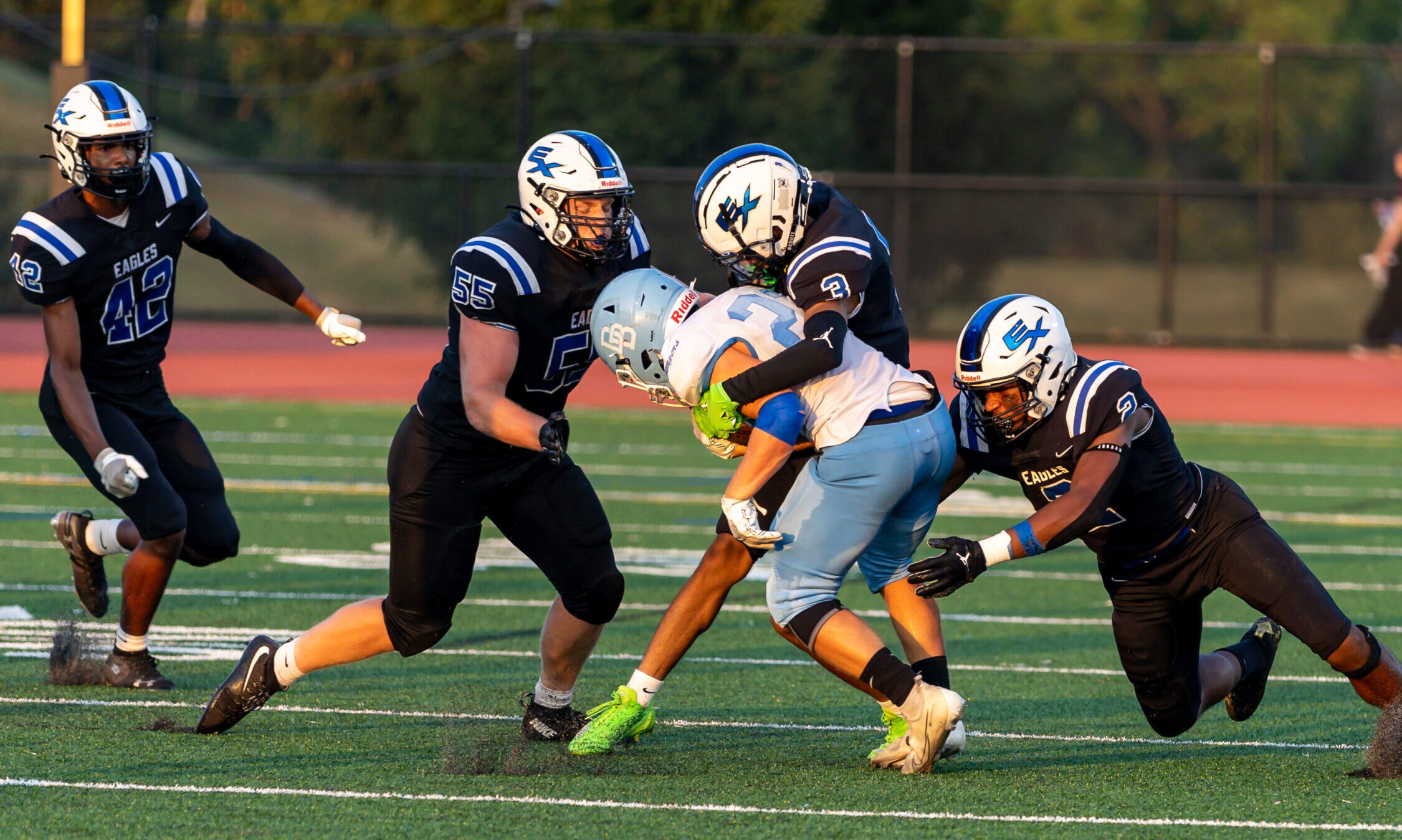
“This defense is up there with any (I’ve had),” head coach Matt Bauer said.
The Eagles won their first district championship last season and had a defense anchored by All-State linebackers Ty Yocum and J.R. Strauss.
This Eagles team is allowing half as many points (11.4 per game), 40 fewer rushing yards per game and 50 fewer total yards.
You would have to go back to 1998 to find an Exeter team allowing fewer points or rushing yards than this one. Over the last 20 years only the 2015 Berks Section 1 championship team, anchored by Michal Menet, allowed a lower yards-per-carry carry average. Only twice in the last 25 years has an Eagles defense allowed so few total yards per game (195).
The most interesting thing about Exeter’s success on defense is that it has succeeded with so many moving parts. It returned six starters but just three remain at the same role as a year ago: Lash, tackle Anthony Caccese and end Joey Reedy. Lucas Palange moved from edge linebacker to the middle; Jovan Hollis moved from outside linebacker to safety; and second-team all-league defensive end Richie Karstien is now used in relief since he’s carrying such a heavy load at running back.
Hollis missed five games at midseason with a shoulder injury but the Eagles didn’t seem to miss a beat.
What’s put this defense over the top have been contributions from some off-the-radar guys — Pashley, Jonathan Martin, Schlaffer and Joel Ummarino — who weren’t in the picture early in the offseason when Bauer and his defensive staff were putting the pieces together.
Pashley, a junior safety, transferred in from Conwell Egan in the spring.
“I had no idea who he was,” said Palange, “(but) he immediately made an impact. He’s been doing amazing back there.”
Martin hadn’t played football since junior high and didn’t make a full commitment until late in the summer. Once he did his athleticism showed immediately, he earned a starting spot at outside linebacker — and a game ball in the season-opener.
“He came out of nowhere,” Palange said. “As soon as he came in you could tell he was really athletic, really dedicated.”
Martin, second on the team in tackles and third in sacks, suffered a season-ending knee injury at Manheim. That opened the door for Ummarino, a 6-2, 210-pound freshman who has taken over that position. Last week, in a 42-12 win over Dover, he made a key play, stuffing a fake punt.
“Even in the spring we knew he was going to be something special,” Lash said of Ummarino.
And then there’s Schlaffer. The Penn State tight end recruit has been a starting receiver since he was a freshman but never played much defense until this season. Now he’s become a force on that side of the ball, too.
The 6-6, 220-pound senior lines up at defensive end or outside ‘backer and causes havoc.
“He’s such a big body that it’s hard to get hands on him when you’re blocking him,” Palange said. “He can shed (blocks) and makes tackles pretty easily. (It’s great) having athletes on the field that you know can make a play any time.”

That includes the 6-6, 280-pound Caccese, a two-time all-league offensive lineman who’s committed to Delaware. He’s played more defense than ever this year and has emerged as a disruptive force; he leads the team with seven sacks, has 14 hurries and has batted down six passes.
Their emergence has something to do with the fact that the Eagles have allowed just 125 rushing yards over their last four games, which includes stops at Hempfield and Manheim Central.
One of the keys to the defense has been Palange’s ability to move seamlessly from the outside to middle linebacker where he directs traffic and leads the team in tackles. He loves playing behind a dominant defensive line which allows him free access to the ballcarrier.
“Putting him on the line of scrimmage (instead of the edge), he can run tackle to tackle, sideline to sideline,” Bauer said, “you’re putting him in a much better situation to be successful.”
It all starts up front with the Eagles. With Lash, Caccese, Reedy, Karstien or Schaffer on the line opposing teams struggle to run the ball consistently. Exeter is allowing a league-low 76 yards per game. No team has reach 100 rushing yards against it since Muhlenberg in Week 7.
That doesn’t bode well for 11th-seeded Northern (8-4), a ground-oriented team that leads with its defense and has pulled out a lot of close games.
“We’re a run-stopping defense,” Palange said. “I wouldn’t have a good time running against this team.”