



Al Wolski faced a big challenge in Reading, and tackled it

Al Wolski calls it “football ego.”
That’s why he moved from Florida to Reading in 1995 and took over a football program that had been torn apart a year earlier by controversy.
He had an offer at the same time to coach in an affluent New Jersey town but chose Reading High instead.
“I thought it was a bigger challenge,” he said.
Wolski, who had been coaching in Florida, wanted to return to his Pennsylvania roots. He was all-league offensive lineman at Phoenixville and West Chester State College. He had spent time at Penn State as a grad assistant.
He grew up on Pennsylvania football and knew well the caliber of play, across the state and in Section 1 of the Lancaster-Lebanon League, which the Red Knights called at the time.
| Wolski’s RHS record | |
| 2003 | 10-2* |
| 2002 | 7-3 |
| 2001 | 8-2 |
| 2000 | 9-2* |
| 1999 | 5-5 |
| 1998 | 7-3* |
| 1997 | 8-2 |
| 1996 | 7-3 |
| 1995 | 4-6 |
He was intrigued by the potential of the largest high school in the state and by the fact that the football program had been mostly subpar for decades, before Jet Johnston pumped life back into in the early 1990s.
Jet crashed and burned in 1994 and the Red Knights went down with him, finishing 2-8. That opened the door for the Wolski era.
“The only way you could go,” he figured, “was up.”
And they did. In his second season the Red Knights won seven games. Two years later they shared the Section 1 title. A couple years later there was another shared Section 1 crown and Reading’s first trip to the District 3 playoffs.
The wave of success crested in 2003. The Red Knights won a program-record 10 games, shared a third league title — equaling the number won in the program’s first century — enjoyed their first playoff win and only trip to a district championship game.
“Things kind of worked out,” said the always-understated Wolski, reflecting on his decision to take the Reading High job and the nine-season run from 1995 to 2003 that ranks as the most entertaining and successful in program history.
Wolski, now 71, will be honored for the indelible mark he left on the Red Knights program when he is inducted into the Berks County Football Coaches Hall of Fame Saturday evening, along with four others.
(It will be his fourth Hall of Fame, following inductions at Phoenixville, West Chester and, last year, by Pennsylvania State Football Coaches Association.)
Wolski spent 33 years coaching football, starting with a junior high gig in 1973 in Union, N.J. He moved on to Penn State, Ithaca College and several high schools in Florida. (He also coached lacrosse, and took Ithaca to three NCAA tournaments.)
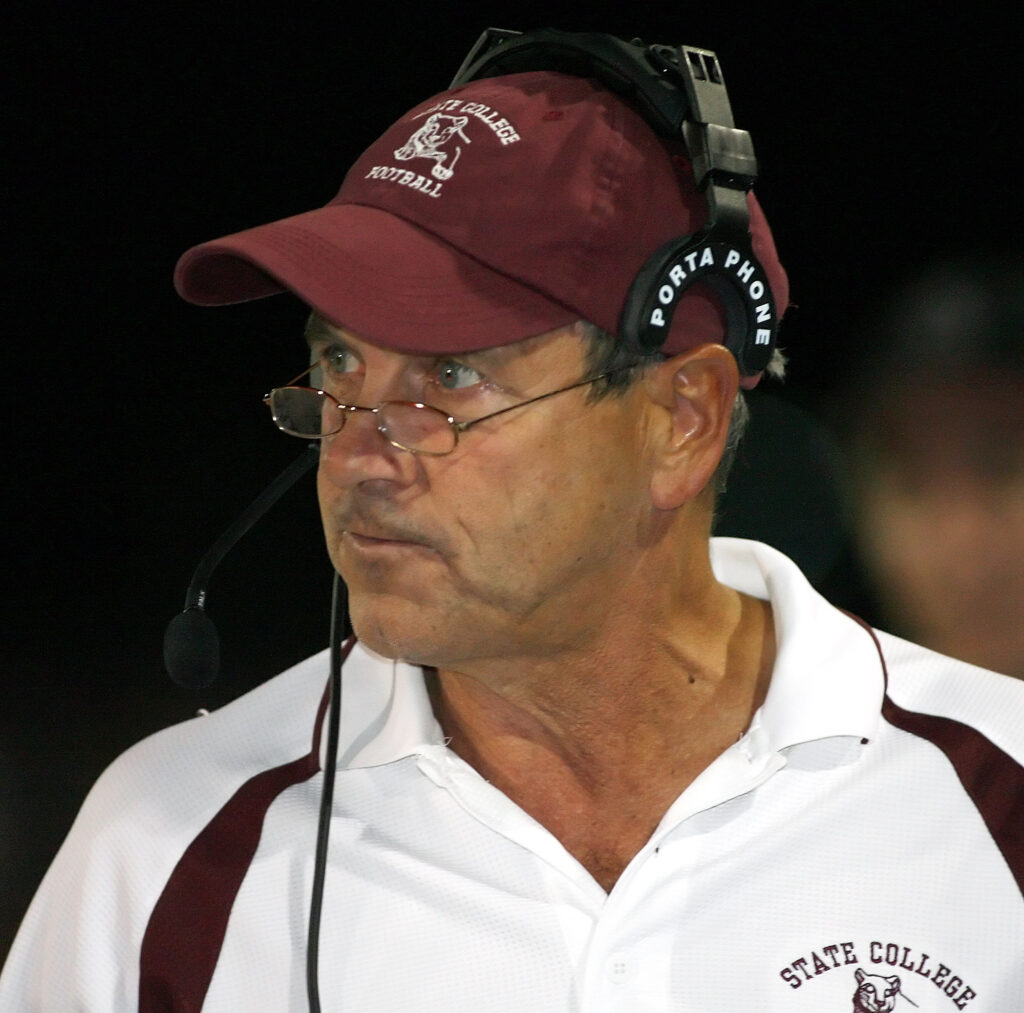
Following the 2003 season he left Reading to take a job he had long coveted, at State College High School. He spent 11 seasons with the Little Lions, going 87-42 with three Mid-Penn Conference championships and 10 postseason trips, including one that resulted in a 2009 PIAA Class 4A title-game appearance.

After 152 career victories and six league titles Wolski retired in 2014.
He now lives in Ocean City, Md., where he spends most days on the golf course, playing pickleball or boating. He and his wife Mary spend their winters in Florida.
A quarter-century after arriving in Reading he still recalls those days fondly, steep as the climb may have been in the beginning.
In typical Wolski fashion he hands off credit for the program’s success to school administrators, his coaching staff and the many talented players he coached: Elly Salamo, Sam and James Bryant, Lamar Stewart, Kalise Cook, Zach Maier, Nico Carwll, Carmelo Ocasio, Nate Luigard and Troy Godinet, who was recently named Red Knights head coach.
“There was a great relationship between athletics and the top tier of administration, (with) the principals, the principals at the middle schools, they all cooperated,” Wolski said. “They felt that one of the ways to help kids was through athletics. They were all cooperative as heck. If you don’t have that kind of support it’s tough to be successful, especially at a place like Reading.”
Wolski’s first task in Reading was recruiting — seeking out players within his own school, and within the district’s four middle schools. He said it was important to have coaches working in the school district, especially in the middle schools, so that they could engage potential players and create lines of communication.
“We had people there on a daily basis — Mike Misch, Gary Mitzel, Sam Johnson, Jeremy Crills — trying to recruit new kids,” he said. “I told them: ‘If you see somebody that looks like they could be a player, talk to them.’ My plan was to come in and recruit and have people in the building at all time. We realized that was going to take time.”
It retrospect, it didn’t take that long. Wolski won his first game, 17-13 over Boyertown; the players presented him with the game ball. The first season ended with four wins, double the total of the previous season. Seven times in the next eight seasons the Red Knights won seven or more games.
The program had never known a sustained run of success such as that before, not even during the Andy Stopper glory days of the 1950s when Lenny Moore and the Jankans brothers — Bart and John — had the Red Knights at the top of the powerful Central Penn League.
It certainly has not happened since Wolski departed. In the 17 full seasons since they have had two winning records and finished .500 once. The last four coaches, combined, won 53 games; Wolski went 65-28. His .699 winning percentage is easily the highest in program history.
Of the other 34 Reading coaches only one, Paul Reed, who coached during World War I, won more than 60 percent of his games. (Only seven Reading coaches have left with a winning record.)
Wolski, always a run-first guy, brought the Wing-T and option football to Reading. Some questioned it; big schools usually don’t run the Wing, they rely on power football.
Wolski showed that if you have the right people running it the Wing-T can work anywhere, and he certainly had the right guys.
Salamo was a freshman in Wolski’s first season and proved to be a devastating force on both sides of the ball. (Wolski calls him the best player he’s ever coached.) He set a program record that still stands with 340 rushing yards in a game (vs. McCaskey in 1998) and rushed for over 2,000 career yards.
More fast and powerful backs followed in his footsteps: The Bryants, Stewart, Cook, Jason Poulson, Jordan Johnson, Tony Harris.
With Wolski’s best teams, down and distance didn’t matter. Guys such as Poulson, who averaged a staggering 18.2 yards per carry in 2003, or Johnson, who averaged 12.1 yards per carry a couple years earlier, could take it to the house from any spot on the field.
Defenses were sucked in to stop the run, stacking the line; once one of speeding bullets broke through they went the distance.
The Red Knights led Berks in rushing yards five times in a six-year span, from 1998-03, and in total offense three of those years.
The 2001 team, with Alex Johnson at quarterback, Harris at fullback and Johnson and Sam Bryant at halfback, set a Berks record by averaging 43.5 points per game. (In the season-opening win over C.B. East each of the three backs topped 100 yards.)
The 2003 team, with Nick Galan at quarterback, James Bryant at fullback and Poulson and Cook at halfback, was easily Wolski’s best Reading team. It was Reading’s first 10-game winner and produced a winning margin of 32.7 points, at the time third-highest in Berks football history.
It wasn’t just an offensive juggernaut, either: James Bryant was the Berks Linebacker of the Year, Cook the Defensive Back of the Year and Luigard the Defensive Lineman of the Year. Through its first nine games — all wins — the defensive unit scored more touchdowns than it allowed. Think about that for a moment.
The Red Knights were at their devastating best in a Week 9 showdown against Wilson and its legendary quarterback Chad Henne, a senior headed for Michigan, and then the NFL. James Bryant played the game of his life that night, making some punishing tackles on Henne and a devastating blindside hit on wide receiver Jim Geosits that rocked Gurski Stadium.
The Red Knights won 44-2, easily one of the worst home defeats the Bulldogs ever absorbed.
“When we turned around and looked behind us it seemed like all of Reading was there,” Wolski said of a crowd in excess of 7,000. “It was neat to bring the community together; they were all talking about (football). Bringing the city together, that was probably the most rewarding thing.”
Full list of Berks County Football Coaches Hall of Fame members