



Decades later, Pete Gilmore remains ‘second to none’ among Bulldogs backs
2026 Berks football coverage presented by
Utilities Employees Credit Union

When they heard Jim Cantafio was coming in as the head football coach, Pete Gilmore and his Wilson teammates had some apprehension.
The Bulldogs’ success formula went back decades, to the John Gurski 3-yards-and-a-cloud-of-dust days, and they didn’t need anyone messing with that.
“We did our research and saw that when he was at Wyoming Valley West, he was throwing the ball all over the yard,” says Gilmore, a bruising tailback who had rushed for nearly 1,200 yards as a junior. “It was concerning.”
Cantafio knew where his bread was buttered. He saw that the Bulldogs had a huge offensive line in 1999 and a game-changing tailback in Gilmore; he used that formula to unlock one of the best seasons in program history.
In the biggest moment of a 12-win, district championship season, a Week 6 match-up against nationally ranked Manheim Central, Cantafio called Gilmore’s number time and time again.
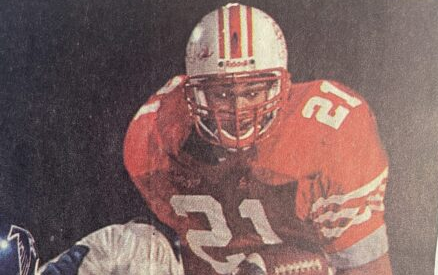
The Penn State-bound senior responded with one of the greatest, and gutsiest, performances in Berks history, slamming the line 43 times, rushing for 303 yards, and scoring four touchdowns in a 34-29 victory before some 8,000 people at Gurski Stadium.
“He basically carried us, singlehandedly,” says Doug Dahms, the Bulldogs defensive coordinator at the time and their head coach for the past 20 seasons.
| Class of 2026 | |
| Gooch Adams | Wilson |
| Dave Bodolus | Daniel Boone |
| Chuck Brice | Holy Name |
| Pete Gilmore | Wilson |
| Nate Romig | Daniel Boone |
| Dr. Randy Yocum | Sch. Valley |
That was a highlight in a four-year career jammed with them, one that saw Gilmore part with program records for rushing and scoring and with a resume sparkling enough to earn a spot in the Berks County Football Coaches Association Hall of Fame.
He’ll be inducted June 6, along with fellow Class of 2026 inductees Gooch Adams, Dave Bodolus, Chuck Brice, Nate Romig, and Dr. Randy Yocum.
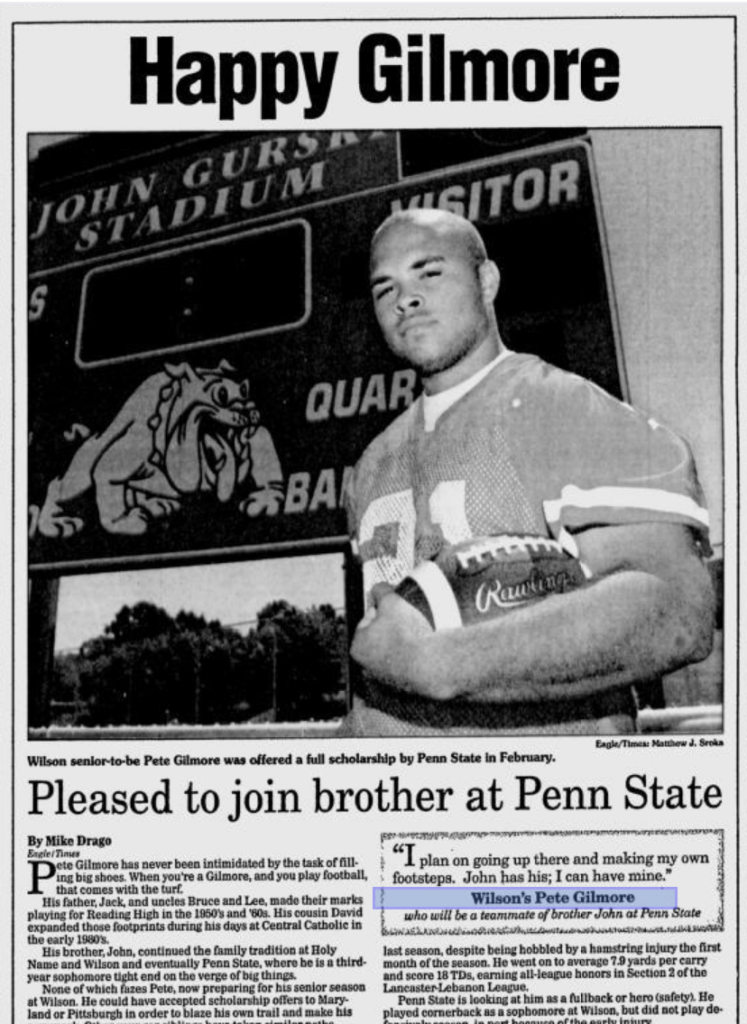
Gilmore was Berks Player of the Year, Berks Offensive Back of the Year, and an All-State and Big 33 selection as a senior in 1999, when he set program records with 1,810 rushing yards and 33 touchdowns.
Despite starting at tailback only in his final two seasons (Michigan State-bound Alex Auston was ahead of him in 1996 and 1997) Gilmore established program career records with 3,506 rushing yards and 61 touchdowns.
He was a three-year starter at cornerback and played on three Lancaster-Lebanon League Section 1 championship teams.
Still, when he bumps into people from back in the day the first thing they mention is the magical Manheim game.
“That’s one that will go down in the books,” he says graciously.
Indeed, it was easily one of the most hyped games in Berks football history. The intensity was generated by the fact that a year earlier the Bulldogs felt they were robbed in a 19-14 loss at Manheim, costing them a share of the Section 2 championship.
Barons quarterback Jeff Smoker, a Michigan State recruit trying to rescue his team in the final minute, appeared to fumble the ball on a pass attempt, with the Bulldogs recovering. It was ruled an incompletion, Manheim retained possession, and Smoker delivered the game-winning TD pass with nine seconds remaining.
That controversial ending, paired with a long-established battle between Cantafio – who had coached at Manheim rival Conestoga Valley – and Barons coach Mike Williams, heightened the interest for this midseason clash of unbeatens.
“I can remember sitting in English class (the day of the game) and people were already (in the stadium) setting up for the game,” Gilmore recalls. “When I heard that, I started to get in the zone. I didn’t talk to anyone the rest of the day.”
Gilmore turned the showdown into a one-sided affair, scoring a pair of early touchdowns that gave the Bulldogs a 21-0 lead. The 5-11, 210-pound Gilmore kept pounding the rock throughout, smashing the Barons defense and the program record for carries in a game. He paused only occasionally to head to the sidelines and lean over a trash can.
“I was throwing up throughout the game,” Gilmore recalls of being so exhausted from his output.
The Barons closed the gap, with Smoker throwing a pair of TDs in the final minute.
“They threw the ball right over the top of my head (on one score),” Gilmore recalls. “I missed it, and I just laid on the ground. I was spent.”
Smoker’s late heroics weren’t enough to save the Barons this time; Gilmore had made sure of that.
Cantafio often said: “Pete Gilmore is second to none.”
A quarter-century later that remains true. He still owns Wilson career records for touchdowns, points, and rushing yards. Impressive for a program that has produced elite ballcarriers such as Mike Reitz, Jeff Niedrowski, Auston, Jami Sands, and Rodney Gillen.
“Pete just had a knack,” Dahms said. “He had good speed, but not great speed. They always say the great runners let people get close, then make ’em miss. That’s kind of the way he was. He wouldn’t take a big hit. He might deliver a big hit, because he was a pretty physical specimen.”
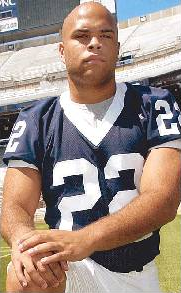
Gilmore went on to play at Penn State for three years but never saw much time in the backfield. He played behind noted tailbacks such as Eric McCoo, Omar Easy, and Larry Johnson.
“The running back room was full,” he says.
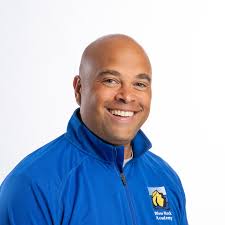
Gilmore stayed at Penn State and earned his diploma; today he’s the Regional Operations director at River Rock Academy, overseeing five schools in the region.
His memories with the Nittany Lions are fond ones, especially the fact that he got to play a season with his brother John, a senior tight end during Pete’s freshman year.
“I love, love, loved Penn State,” Gilmore says, “from Coach (Joe) Paterno to his coaching staff. To this day, there’s a lot of things that Coach Paterno instilled in me.”
Gilmore played for Hall of Fame head coaches at Wilson, Cantafio and Gerry Slemmer, and appreciates everything they did for him. The coach who impacted him most was the one right at home: His dad Jack.
“He was my No. 1 coach, and I’m sure John would say the same,” Gilmore says. “He’d throw the ball to us in the back yard. We had tires set up, we’d run the hills, and he’d be out there coaching us. He was always our No. 1 fan. He would coach us up, and he still does to this day.”
Gilmore was a slam-dunk Hall of Fame pick but that doesn’t make him any less appreciative of the honor.
“When you receive an award of this magnitude, it’s never done individually,” he says. “You’ve got all your coaches, all your teammates, your family members supporting you, your trainers, your fans, your teachers. I wasn’t the best in school, but the teachers were there supporting me. I just appreciate and thank everybody who played a part in my success.”